My family and I recently enjoyed the first real family vacation we’ve had in over two years. The drive (over Easter weekend) was hell, hotels were difficult to find, and packing was nightmarish since we had to prepare for everything from 20 – 90 degrees. But our trip focused on the two national parks best known for their incredible biodiversity. So here, with some great photos from my daughter (and a few from me), I present Five Amazing Things from our trip to the Everglades and the Smoky Mountains National Park.
#1 – Spring Preview
To drive south in March and April is to watch a time lapse film of the seasons changing. We left Ohio in snow. As we drove through the Virginias, tree tops began to turn faintly scarlet and chartreuse, more noticeable by the mile. By the time we hit the Carolinas, redbuds were in full purple flower, outbreaks of daffodils brightened the roadsides, the sky lost its sickly gray tint and dazzled us with blue. And by Georgia, we walked out of the car into the warm embrace of summer.
Unfortunately, we had to head back north where Ohio was waiting for us — storing up another week of snow (or two). But it was balm for my cabin fever to spend a few days in the Florida sun. And on the way back, we had a short hike through an amazing array of spring wildflowers in the Smoky Mountain National Park — a reminder of good things to come as the bloodroots begin to unfurl here in Ohio. I am awaiting spring like an impatient lover.
#2 – Birds
For many years we lived in a home tucked away in a remote location — a sizeable woods behind us, a long driveway, multiple acres of meadow on both sides, all separating us from neighboring houses. One afternoon, home alone, I heard strange noises coming from the yard, as if three busloads of noisy young children had suddenly materialized on our vast lawn; but when I went to the window I saw nothing. Curious, I stepped onto the porch and traced the noise to the bigtooth aspen that loomed over the turn in our driveway. The sprawling 50-foot tree was completely filled with black birds. Every branch held several of the raucous creatures, chattering to one another in a range of pitches and tones, like a bumper crop of noisy dark fruit. I imagine they were European starlings resting during a migration. I stood on the porch watching and listening in amazement. When they finally left, the whole flock lifted from the tree as one. The sky above our house blackened, the sun shaded from the vast number of them. Never before or since have I witnessed such a spectacular gathering of wildlife.
Until this trip.
When we first started planning a family trip to the Everglades, I wasn’t certain what to expect aside from alligators and swamplands. I thought the wildlife would be similar to what we had seen on trips to Galveston and other south Texas coastal regions. As we headed down the coast along the Atlantic, I saw familiar birds: brown pelicans, gulls and terns, egrets.
But the park itself was beyond any roadside sightings from our past journeys. Of course there were alligators, smaller and more numerous than the alligators we’d seen in Aransas National Wildlife Refuge in Texas. But for me, the main attraction was the birds. Everywhere we looked there were huge showy birds: double-breasted cormorants, blue, green, and tri-colored heron, long-beaked ibis and limpkin, egret, familiar crows, even pink roseate spoonbills. We saw nests of fledgling anhingas, still fuzzy and white. We saw a great blue heron spear and eat a fish a few feet away from us. We spotted a barred owl nestled quietly under a bridge.
Most incredible of all was seeing the nesting areas. As memorable as my previous bird encounter was, it paled in comparison. The first nesting area we saw was mostly filled with wood storks – 3-foot black and white birds with 5-foot wingspans. The trees were teeming with them. The nesting area was kept safe from human intervention by a huge pond. But even from across the pond, the sound was deafening. This is what America once was, I thought to myself.
# 3 – One of the most fascinating and changing ecosystems on earth.
Because we went during the dry season, the few pools of water still remaining were thick with wildlife. Although access through the park is limited, there were ample opportunities to walk or even bicycle or take a ranger-led tram ride through different habitats and get a close view of the residents.
Always in a natural area, I love learning about the connections and relationships that mold an area and make it unique. How the plants and animals have adapted to fit the environment, and how they in turn shape the land. For example, as an alligator digs a hole for itself it creates a mound of nutrient rich dirt where a tree might grow, provided it can stand having wet feet most of the year. The few trees that can survive these conditions (mostly cypress and willows) create a concentration of tanic acid when their leaves fall, which eats away at the limestone bedrock and creates deeper waters. The combination of trees and alligators create these areas of deep water surrounded by trees. They are called called hammocks and are scattered across the sea of grass.
I tried to imagine what it would be like to cross this deceptive land on foot. What looked like a hill of trees, was actually a spot of deep water. What looked like solid ground was several inches of water hidden by grass. Had I not known better I would have thought I was looking across a prairie.
Not all species in the park are doing well. The accidental introduction of the Burmese python into this park and surrounding areas, has had a devastating effect on small mammals and other larger species. It may be heart-breaking to watch how this invasive species changes the park. Or nature may find a way to overcome our meddling as it often does.
#4 – A Humble Ecosystem Star
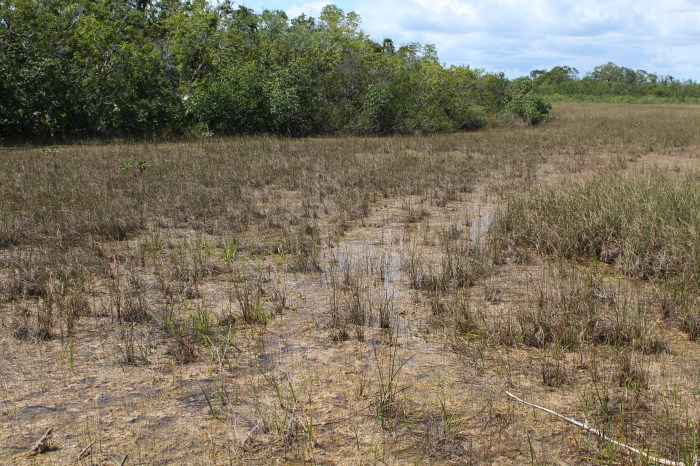
Because complex relationships in nature have always captured my interest, I was enthralled by the real star of the Everglades — which is neither plant, animal, bird nor mineral. Going there during the dry season as we did, we had a good view of the periphyton that mats over the entire park’s surface and that of the neighbouring Big Cypress Preserve’s marl prairies. Although it still appeared brown and lifeless during our visit in early April, I learned this material is the key to the entire ecosystem.
Periphyton is a community of organisms including blue-green algae, fungi, bacteria, microbes, decaying plant material, and even small insects and other organisms that use it as a home. During the dry season it acts as a sponge and preserves a wet environment for frog eggs, worms, and other small creatures that need a moist place to wait out the driest months. Our ranger guide explained that, because it collects detritus from decaying plant materials, the periphyton also helps maintain the impressively clear water of the Everglades — clear enough to spot the spots on the gar swimming below the surface, and clear enough to provide water for thirsty cities like Miami.
During the wetter months, the blue-green algae conduct photosynthesis and are the primary food source for snails, insects, small fish, even baby alligators, creating the first level of a complex food web that sustains multiple top level predators — mammal, reptile, and bird. The photosynthesis also helps maintain levels of dissolved oxygen in the water for fish and other aquatic life to thrive. And as the photosynthesis churns away, it creates pockets of less acidic water. In these areas, the limestone bedrock of south Florida resolidifies into a special kind of mud that helps plant life take hold. While we were there, you could see the limestone crust covering much of the surface of the park. I regret not grabbing a handful of this stuff out of the water and seeing what I could find underneath.
As I stared down at the limestone mud from the walkway, a fellow tourist walked by. “Anything to see?” he asked, camera ready. I’m sure he was expecting a turtle or submerged alligator. But what had caught my eye was a few tiny purple flowers blooming out of the grayish surface — a first sign of life reemerging. He was less impressed than I was. While not as flashy as the birds or butterflies we saw, nowhere as cute as the skinks and painted turtles, it was the periphyton that I researched back in my hotel room after the tour.
We fill our photo albums with close-ups of large creatures, sweeping unique vistas, and funny road signs. But like our vacations and holidays, all these grand and memorable things have their start in quiet everyday processes that are less attractive, but more vital.
Watch a delightfully cheesy park video abut Periphyton.
#5 – Revisiting an Old Friend
Jeff and I had been to the Smoky Mountains before, but our kids had not. In fact, we spent our honeymoon in a cabin near the park. My son and I hiked up the steep walkway to the highest point in the park — Clingman’s Dome at 6,643 feet. A comment posted on the park website sums it up nicely: “The Clingmans Dome hike is fully-paved and only half a mile. However, the steep gradient combined with the high altitude may make the hike too strenuous for the elderly or those out of shape.” (I discovered we’re out of shape.)
Ironically, the observation tower at the top of the peak is the identical twin of one we climbed in the Everglades. The weather was much nicer in Florida, but the view from both walkways was amazing. There is something comforting to be in a place and see nothing but nature all around you for that many miles.
All this I had seen before. I just needed a reminder. But heading out of the park, I saw something for the first time: A black bear in the wild. It was several feet up the mountain side, and masked by forest, but we were able to watch the bear make his way slowly through the emerging spring growth. Even though Jeff and I have backpacked in a wilderness area thick with black bear, neither of us had ever seen one in the wild. You think you know a place and it surprises you again!
Hope you enjoy these photos as much as we enjoyed taking them!


 Branches & Rambles